Service
Nonlinear Abaqus FEA
Abaqus-based finite element modelling for components, supports, tanks, connections, and industrial assemblies where simplified checks cannot represent the real response.
Nonlinear Abaqus FEA · Extreme loads · Industrial integrity
Axis FEA helps engineering teams evaluate LNG tanks, offshore assets, bridges, industrial components, supports, and retrofit options using nonlinear finite element simulation, transparent assumptions, and technical reports built for engineering decision support.
Services
Axis FEA supports local failure, nonlinear material behavior, contact, blast/VCE, thermal gradients, cryogenic exposure and structural-integrity questions that need high-fidelity finite element modelling.
Abaqus-based finite element modelling for components, supports, tanks, connections, and industrial assemblies where simplified checks cannot represent the real response.
Dynamic simulation support for accidental explosion, vapor-cloud-explosion, impact, and impulsive loading scenarios affecting structures and industrial systems.
Simulation of cryogenic spill, low-temperature exposure, transient heat transfer, thermal stress, and integrity-relevant response in LNG/LN₂ containment and support systems.
Local finite element assessment for industrial assets where connection behavior, supports, discontinuities, thermal gradients, or accidental loads control integrity decisions.
Advanced numerical modelling for masonry bridges, arch structures, retrofit concepts, blast response, seismic vulnerability, and damage-mechanism interpretation.
Advanced Abaqus support for engineering teams, graduate researchers, R&D groups, and consultants who need defensible modelling, documentation, and technical communication.
Why Axis FEA
A simulation result is only useful when the modelling assumptions, numerical checks, limitations and engineering interpretation are clear. Axis FEA is built around producing results that can be questioned, reviewed and defended — not just attractive contour plots.
Mesh sensitivity, energy balance, contact behavior, boundary conditions, units, load paths and response histories are reviewed before conclusions are drawn.
Advanced simulation is the core service, not an add-on to general structural design or drafting work.
We define what simulation can answer, what it cannot answer, and what information is needed before budget is spent.
Assumptions, material models, loading, boundary conditions, limitations and interpretation are documented clearly.
Case Studies
Selected cases show the technical base behind Axis: published bridge-blast modelling, LNG vessel–flange vulnerability, cryogenic thermal loading, and XFEM crack-growth workflows.
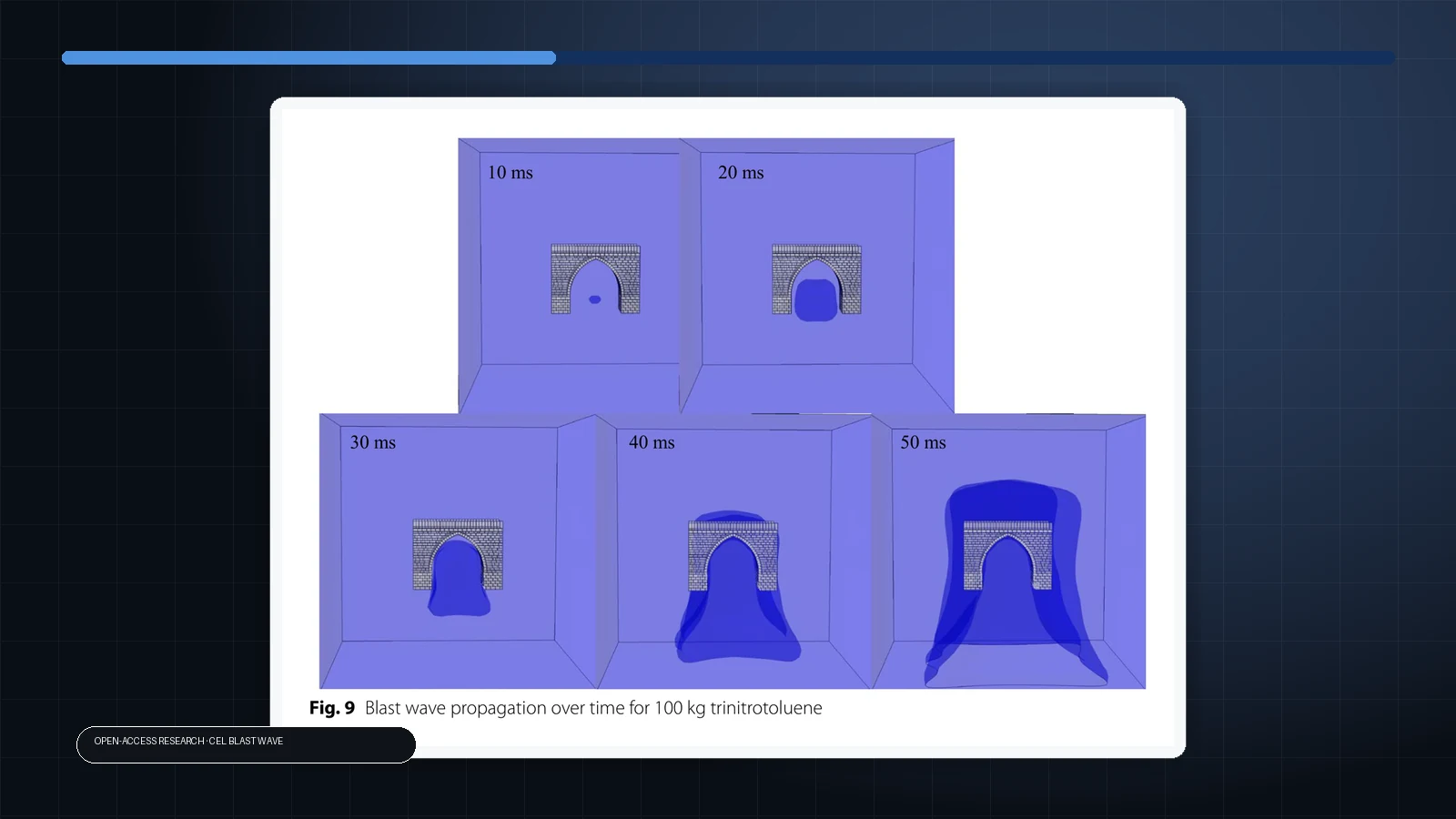
Peer-reviewed Abaqus/Explicit CEL blast simulation of a CFRP-strengthened masonry arch bridge, with JH-II masonry, Mohr–Coulomb backfill, JWL TNT and VUMAT-based material implementation.
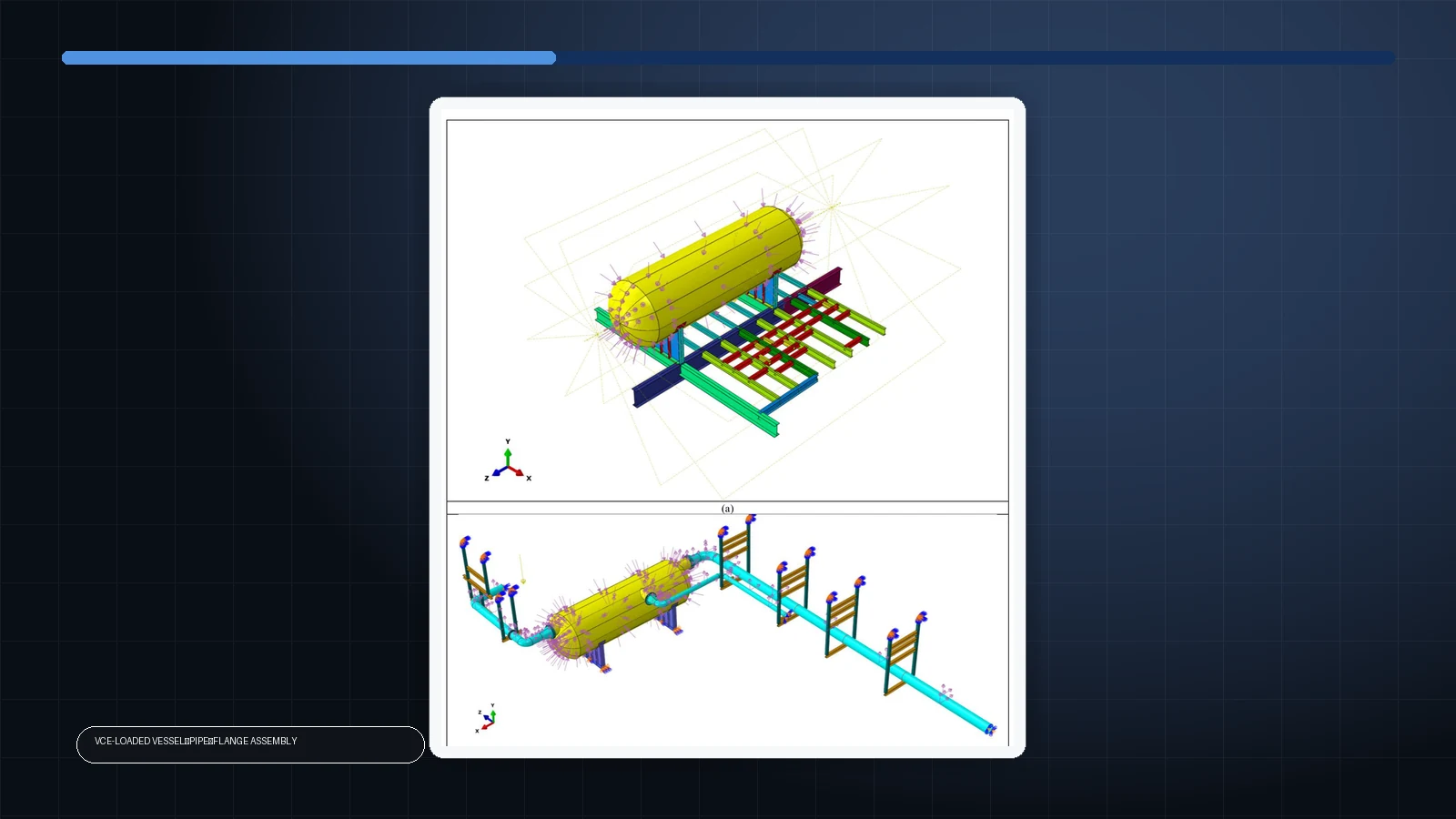
Nonlinear structural–environmental assessment linking VCE-induced local deformation in a connected LNG vessel–pipe–flange system to credible cryogenic-spill initiation regions.
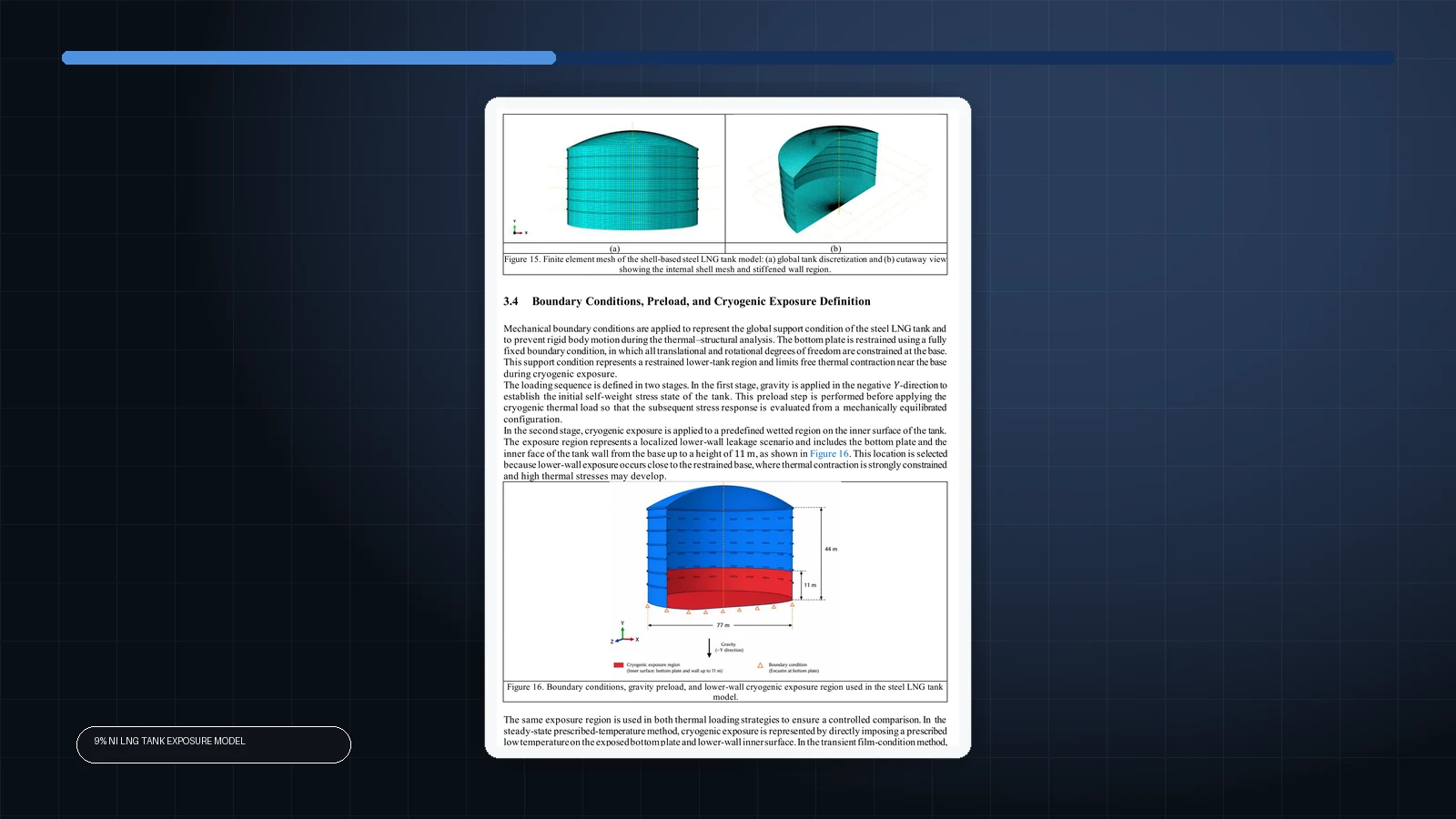
Finite element comparison of prescribed-temperature and transient film-condition thermal loading for cryogenic spill-induced stress in a shell-based 9% Ni steel LNG tank.
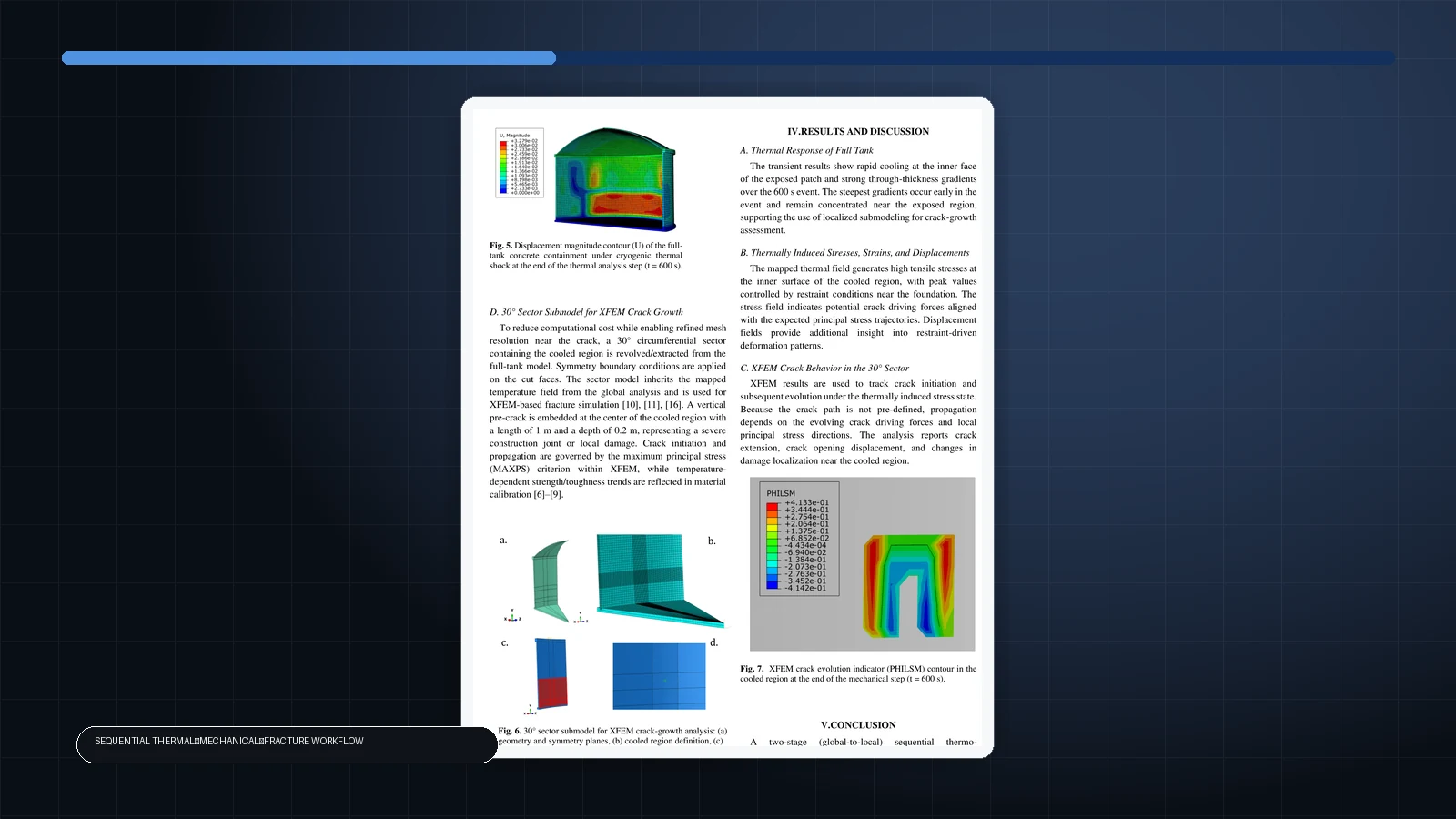
Sequential thermal–mechanical–fracture workflow for pre-cracked concrete outer containment under localized cryogenic spill thermal shock.
Process
Clarify the decision the simulation must support.
Check geometry, data, loading, outputs and assumptions.
Develop the Abaqus model with appropriate detail.
Review mesh, contact, energy, units and response histories.
Deliver figures, interpretation, limitations and next checks.
Technical intake
Axis FEA reviews whether Abaqus-based simulation is suitable, what assumptions are needed, and what deliverable level is appropriate before work begins.